
The largest, cheapest source of new electricity in New England
Harnessing Aroostook County’s abundant wind resource to generate renewable energy for homes and businesses in Maine and beyond
King Pine Wind will bring numerous advantages, including reduced energy costs for customers and economic benefits for Aroostook County and across Maine while providing a cleaner, healthier environment. This Maine-made, clean energy source will help to:
- provide local economic benefits
- lower electricity costs
- increase winter reliability
- improve energy security
- reduce carbon pollution
Long-term Benefits

Ratepayer
- King Pine Wind’s zero fuel cost will displace more expensive generation and lower market prices, offsetting the cost of transmission infrastructure
- A new transmission infrastructure in Aroostook County can provide benefits for future reliability and economic opportunities
- Provide protection against winter price spike events

Economic
- $300 million in-state spend during development and construction; 3,200 jobs (full-time equivalent)
- $125 million in-state spend during operations; 30 full-time jobs
- Leverage Maine’s experienced engineering, consulting, and construction supply chain
- Employment opportunities during construction, skilled wind technicians, operations staff, and support functions
- Realize ~$60 million in property taxes
- Community Benefit Package: State required minimum of $4,000/turbine per contract year, however King Pine Wind intends to grant a higher-value package

Environmental
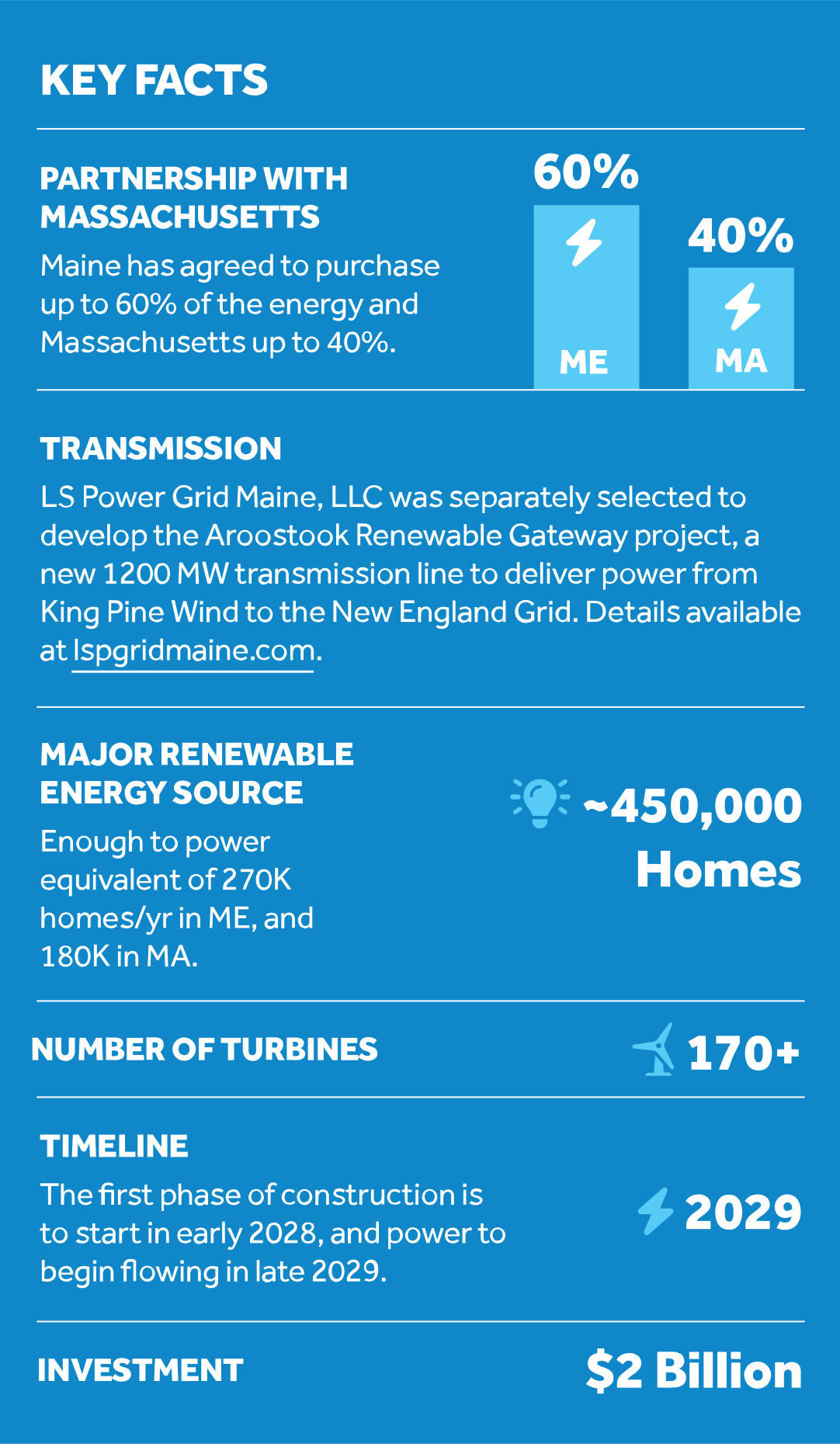
- Generate ~ 3 billion kWh/year of renewable energy, enough to supply ~ 450,000 electricity customers
- Achieve ~ 1.3 million tons CO2 avoidance/year, equivalent of removing ~ 260,000 passenger vehicles annually
Project details
| Developer | King Pine Wind Maine, LLC (a subsidiary of Longroad Development Company, LLC) |
| Location | Centered in and around Webbertown Township, west/northwest of Houlton, generally north of I-95 between Route 1 and Route 11 |
| Project Size | 1,000 MW (~170 turbines) |
| Total Project Area | Approximately 4,500 acres |
| Expected Construction Start | 2028 |
| Development Costs | ~$2 billion, with an estimated ~$425 million spent with Maine vendors |
| Property Tax Revenue | ~$60 million |
| Local Community Benefits | $4,000/turbine/year minimum |
FAQ
Location
-
Where will King Pine Wind be located?
King Pine Wind will be centered in and around Webbertown Township, west/northwest of Houlton, generally north of 1-95 in the area between Route 1 and Route 11 on actively managed, private commercial timberland.
-
How many acres will King Pine Wind require?
King Pine Wind will encompass approximately 4,500 new and previously cleared acres for roads, turbine pads, and electrical lines (subject to final engineering). Where possible, the project will utilize approximately 500 miles of existing logging roads within the project area and except for new graveled roads, parking areas, substations, and project offices, most of the land utilized will be maintained as trees and shrubs.
-
How will King Pine Wind impact recreation in the area?
Except when the project is actively under construction, there will be minimal changes to existing uses of the property for recreation, including hunting, fishing, and snowmobiling. Land that is not utilized by the project will remain under the control of the underlying landowner.
Benefits
-
How will King Pine Wind impact Maine electricity rates?
King Pine Wind, in combination with a new transmission line to be developed by LS Power Grid Maine, LLC (collectively, the Project) will deliver net positive benefits to Maine ratepayers. Energy produced by King Pine Wind will be purchased via a 20-year power purchase agreement (PPA), while the transmission line will be funded by a separate transmission agreement (TA). Maine utilities will purchase 60% of the energy (with an equal share in transmission funding), while Massachusetts utilities will purchase the remaining 40%.
The low cost of energy produced by King Pine Wind will more than offset the cost of transmission. According to an analysis by Daymark Energy Advisors, King Pine Wind and the associated transmission will result in meaningful savings for ratepayers across the state, including northern Maine. Savings are a result of direct contract benefits (King Pine Wind pricing is less than the market price of power) and regional suppression of wholesale price of power, by reducing reliance on inefficient and expensive fossil fuel-fired resources and lower wholesale electricity market prices.
King Pine Wind will also protect against winter price spike events. Winds are strongest in northern Maine during the winter when natural gas supplies are constrained and energy prices can spike in New England. Large-scale wind resources like King Pine Wind can ease these constraints, encouraging downward pressure on energy prices and improving system reliability.
-
What economic benefits will King Pine Wind deliver for Maine, Aroostook County, and local communities?
In addition to ratepayer benefits, Aroostook County citizens and businesses, and Maine in general, will benefit from King Pine Wind’s substantial in-state spending on project planning, construction and operations, property taxes, and a broad range of community-specific benefits.
According to an analysis performed for King Pine Wind by Dr. Ryan Wallace, the economic benefits to Maine are estimated to include (all figures approximate; includes direct, indirect, and induced):
Development & Construction:
- $300 million in-state spend
- 3,200 jobs (full-time equivalent)
Operations:
- $125 million in-state spend
- 30 jobs/year
Property taxes:
- $60 million
- Creation of TIF districts could maximize benefits to Aroostook County
State law requires King Pine Wind to provide at least $4,000 per turbine, per year, in host community benefits, however the project intends to design a higher value community benefits package.
During development and construction, King Pine Wind will leverage Maine’s experienced engineering, consulting, and construction supply chain. In addition to opportunities for local hiring, the project will require lodging, food, fuel, and regional supply chain support for a variety of services.
During operations, the project will create opportunities for skilled wind turbine technicians, operations staff, and a host of maintenance support functions.
The project establishes new transmission infrastructure from the New England grid into Aroostook County, an asset that may be essential for future reliability and/or economic opportunities.
-
What environmental benefits will King Pine Wind deliver?
The key environmental benefit from King Pine Wind is the generation of carbon-free electricity generation which will displace fossil fuel sources of energy. Climate change is having an impact on not only individual species, but entire ecosystems. One solution to reduce the growing impact of climate change is to rapidly deploy carbon-free energy generation, like King Pine Wind, to replace fossil fuel plants.
In 2019, Maine passed legislation requiring 80% of retail electricity to be provided by renewable resources by 2030, and 100% by 2050. In 2020, the Maine Climate Council established a goal to reduce greenhouse gas emissions by 45% by 2030 and 80% by 2050. King Pine Wind will move Maine closer to meeting these goals by reducing our dependency on fossil fuel generation, since natural gas generators on average make up approximately half of the current regional supply mix.
According to a report prepared for King Pine Wind by Daymark Energy Advisors, the project will displace approximately 1.3 million tons of CO2 per year, the equivalent of removing from the road approximately 260,000 passenger vehicles annually.
-
What are the benefits to multi-state cooperation?
As with other forms of manufacturing and sale of goods, Maine ratepayers will benefit from the economies of scale realized by a larger project, e.g. the cost of electricity for a large project is inherently less expensive than a small project. Massachusetts has agreed to purchase 40% of King Pine Wind energy and associated transmission costs which allows for Maine ratepayers to benefit from the economies of scale without having to purchase the full output of the project or pay for 100% of transmission costs. Additionally, as with other products that Maine produces and sells to customers outside of the state, Maine equally benefits from the export of energy in the form of jobs, property taxes, support services, and community benefits.
Massachusetts (and other New England states, such as Rhode Island and Connecticut) are actively pursuing wind projects in the one place with the space and wind resource to do so…offshore. Massachusetts understands the significant benefits of renewable energy, so while they are doing a lot in their state, they are also looking to import some as well. In the process, they’re going to play a substantial role in defraying the cost of the transmission to northern Maine.
Project Details
-
What size turbines does King Pine Wind intend to use? How do they compare to other projects in Maine?
King Pine Wind will utilize the latest wind turbine technology to maximize efficient energy production. While the selection process is still ongoing, the project is evaluating turbines with a nameplate capacity of 4.5MW to 7+MW, with tower heights ranging from 118m-133m (387ft-436ft) and rotor diameters ranging from 150m-163m (492ft-535ft).
For comparison to other operating projects in Maine:
- Mars Hill, circa 2007, utilized 1.5MW turbines on 80m (262ft) towers with 77m (253ft) rotor diameter.
- Oakfield, circa 2015, utilized 3MW turbines on 84m (276ft) towers with 112m (367ft) rotor diameter.
- Weaver, circa 2020, utilized 3.3MW turbines on 117m (384ft) towers with 126m (413ft) rotor diameter.
-
From how far away will King Pine Wind be visible?
Visibility of wind turbines is entirely dependent on the vantage point of the viewer, particularly in heavily forested northern Maine. The state permitting process for wind power includes a thorough review of visual impacts, particularly from any locations of high scenic value in the surrounding area. The King Pine Wind project area is characterized by less pronounced terrain with weaker topographic relief than previous projects in the region, which in combination with the forested land cover will lessen visual impacts. Expected turbine base elevations within the project area range from 770ft to 1260ft, as compared to Mars Hill (665-1710ft) and Oakfield (725-1435ft).
-
What is planned to reduce the impact on the night sky?
Longroad plans to install radar-activated lighting (RAL) on the King Pine Wind turbines to minimize the impact of turbine beacons on the night sky. Radar sensors determine the proximity of aircraft to turn the warning beacons on and off again, so the lights will only be illuminated when an aircraft is in the area.
-
What will be the impact on birds and bats?
King Pine Wind will contribute to the reduction in rising global temperatures, a well-documented threat to wildlife and their habitats worldwide. The Audubon Society estimates that nearly two-thirds of North American bird species are at increasing risk of extinction from climate change, including many Maine resident and migrant species. Likewise, the North American Bat Conservation Alliance identifies climate change as a key threat to bats and notes that renewable energy is helpful toward combating it.
King Pine Wind’s contributions to combatting climate change provide a great benefit to birds and bats; however, constructing and operating a wind energy farm can result in some habitat loss and fatalities. Careful project siting and management of King Pine Wind is crucial to ensuring that impacts on birds and bats is minimized and that the project has a net benefit to their long-term survival. Longroad is conducting intensive studies and coordinating with state and federal wildlife agencies to site turbines and other project facilities away from important habitats and vulnerable wildlife populations. Furthermore, King Pine Wind plans to employ operational strategies and technology to avoid or minimize impacts on bats.
A primary strategy to avoid impact on bats is to reduce turbine operation during conditions when bats are most likely to be present. Bats hibernate during winter months and, in northern Maine, only fly from April to the end of September. During these warmer months turbine blades will not operate during the nighttime at low wind speeds which will reduce the potential impact during their highest activity times.
Avoidance of high use areas with attractants for greater bird use is the key to minimizing the potential effects on birds. King Pine Wind is in a northern Maine forest away from large rivers and the coast which can be higher use areas for birds.
-
After the 20 year term of the PPA expires, what will happen to the project?
Site Location of Development Act (SLODA) permitting through Maine DEP requires that a decommissioning plan and independent cost estimate be approved for the removal of the wind turbines and restoration of the project site. Prior to starting construction, King Pine Wind will be required to post financial security for the full estimated cost of decommissioning, providing Maine DEP with the ability to access funds in the event that King Pine Wind fails to decommission the project once it is no longer operational. Cost estimates and corresponding security are updated periodically over the life of the project to account for changes in cost.
While the initial power purchase agreement is anticipated for twenty years, the project can operate longer either under a new power purchase agreement or as a merchant generator. The project lease agreement with the underlying landowner is for 20 years with an option to extend up to 40 years. Once the turbines have surpassed their useful life and are decommissioned, the majority of materials can be recycled and the site will be restored. Metals such as steel, aluminum, copper have recycle value, and efforts are underway to ensure that the blades (typically of fiberglass) can also be reused or repurposed.
Transmission-Related Questions
-
What is the relationship between King Pine Wind and the LS Power Grid Maine Aroostook Renewable Gateway transmission line?
The Maine PUC conducted separate solicitations for transmission and for generation, selecting LS Power Grid Maine, LLC to develop the Aroostook Renewable Gateway transmission line and King Pine Wind Maine, LLC to develop the wind project separately. There is no co-ownership or joint development of the projects, however both companies continue to coordinate efforts. Both projects will have to be successfully developed and put into service in order for power to flow and the anticipated benefits to accrue.
-
The capacity of the line will be 1,200 MW, but King Pine Wind will be 1,000 MW – will another 200 MW project fill the remainder of the transmission capacity?
The Maine Legislature has recently taken steps to utilize this remaining transmission capacity. On June 22, 2023, LD 1943 passed both the Maine House and Senate, directing the Maine Public Utilities Commission to initiate a procurement for an additional 200MW of renewable power.
Next Steps
-
What are the next steps in the process?
What are the next steps in the process?
Many contractual, permitting and planning activities and milestones must take place before King Pine Wind is ready to begin construction. The following outlines some of the critical activities remaining:1. Energy Contracts
- Power purchase agreements negotiated and executed with Maine and Massachusetts utilities
- Regulatory approval of contracts
2. Interconnection Studies & Approval from ISO-NE
- Release of ISO-NE 3rd Maine Renewable Integration Study (MRIS) results
- Complete Cluster System Impact Study (CSIS)
- Complete Facilities Study
- Execute Interconnection Agreement
3. Local Community Engagement
- Early outreach to provide basic project information and answer questions
- Once field studies and engineering has progressed, and prior to filing permit applications, additional community outreach to provide more detailed information.
- Determine community benefit packages and local taxes
4. Permitting
- Complete environmental studies
- Prepare permit engineering: site layout, civil/stormwater, electrical
- File and secure project permits: local, state, federal
5. Pre-Construction
- Finalize wind turbine selection
- Execute equipment supply agreements
- Execute construction contracts
- Complete detailed engineering and design
- Secure project financing
Construction is expected to start in early 2028, with project energization in phases starting in late 2029.
Longroad’s investment in Maine
Since 2006, our team has invested more than a billion dollars in developing over 800 megawatts of clean energy in Maine. We also employ Maine Maritime Academy graduates and U.S. military veterans at our Scarborough office to operate and manage hundreds of wind and solar projects throughout the country.
Stay informed
Receive updates about King Pine Wind and ways to make your voice heard
"*" indicates required fields