
A proposed solar and battery storage project that will provide sustainable, affordable energy and benefit San Benito County.
On this page:
About the project
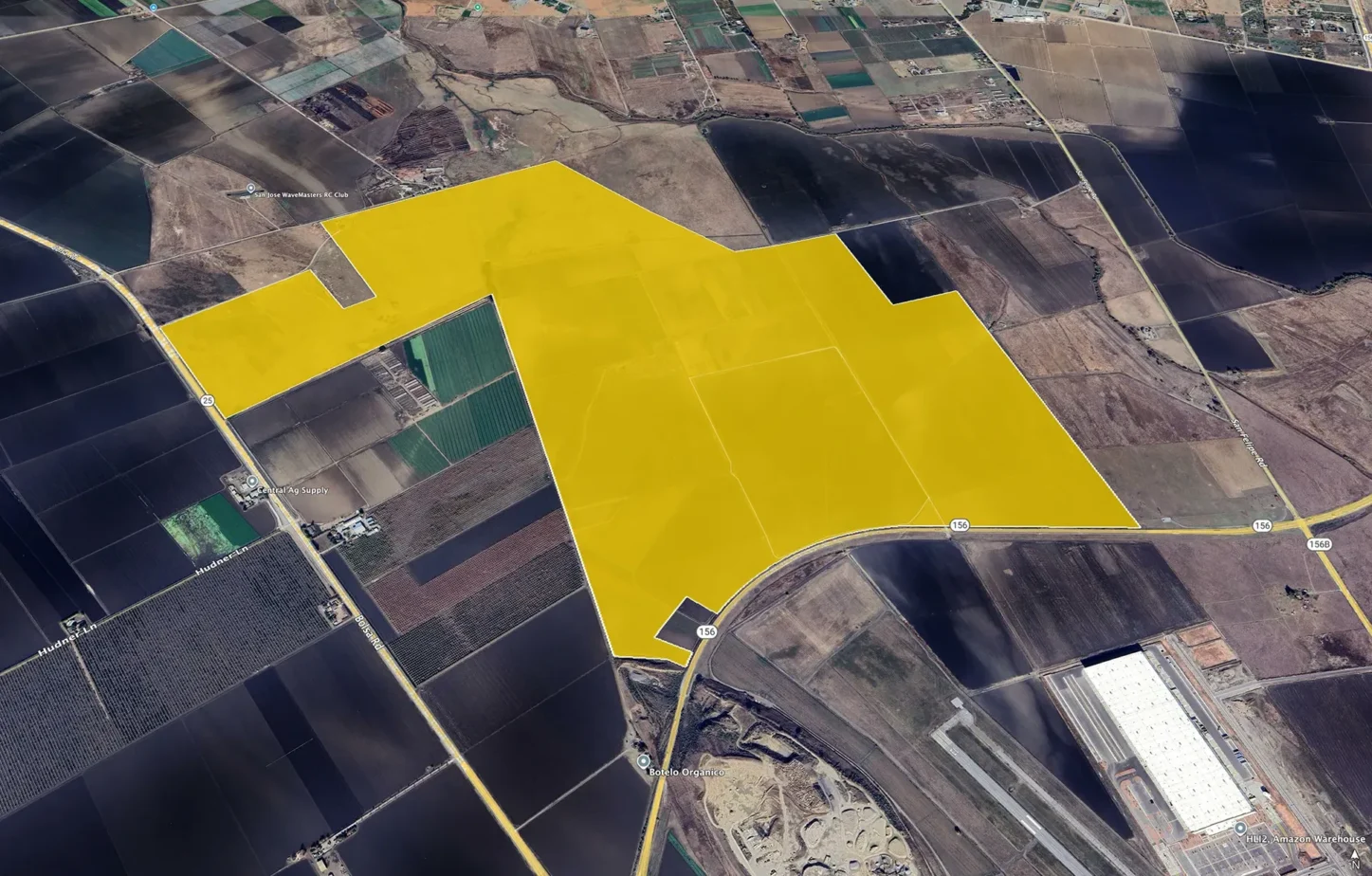
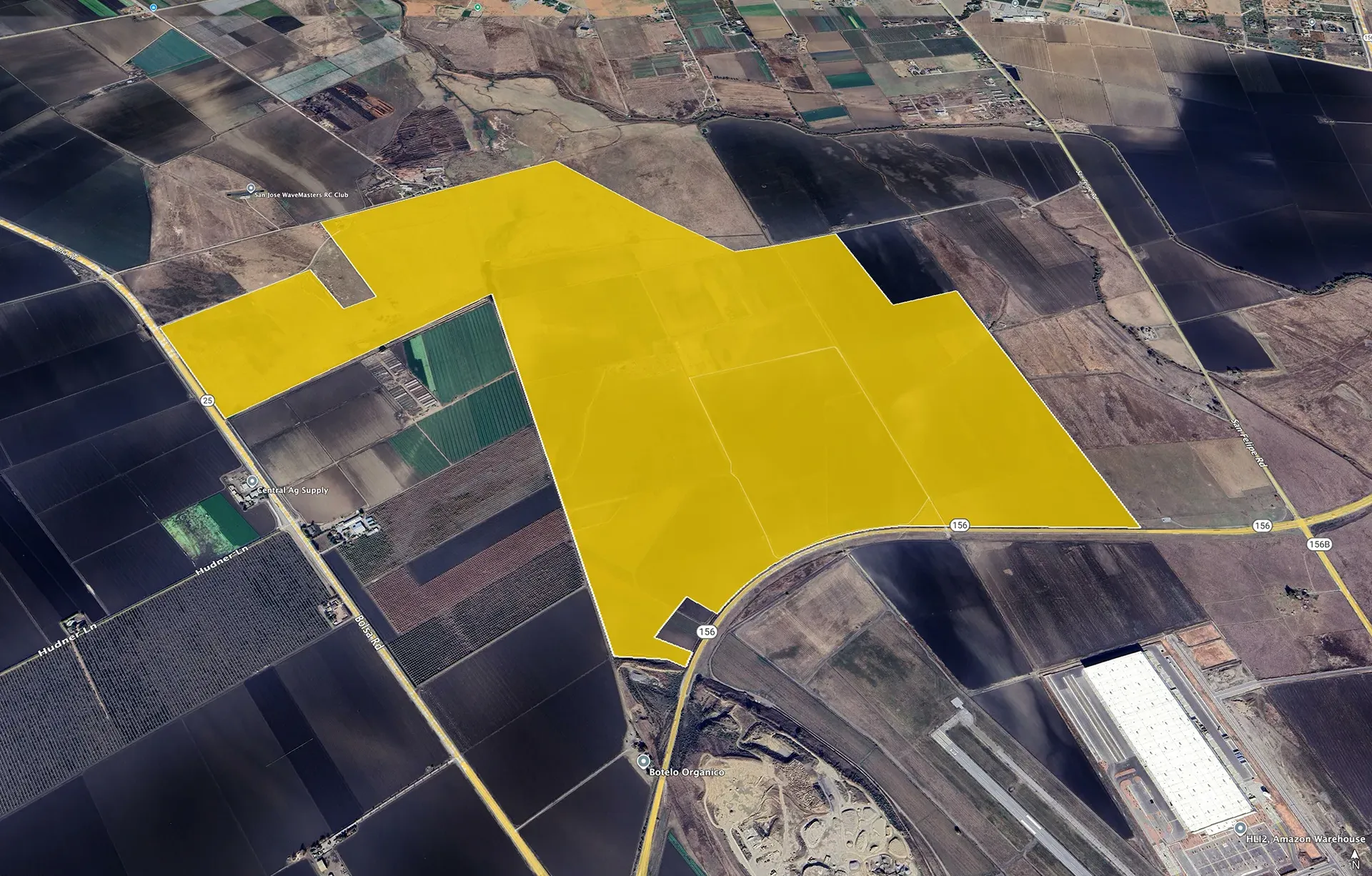
The Allium Project is a proposed solar and battery storage project located on ~945 acres of low-productivity private land in San Benito County, north of the Hollister airport. The Project will generate clean, American-made energy and provide a reliable supply of power to California’s grid, even during peak demand. Allium will deliver:

Sustainable, affordable energy + increased reliability
110 MW of solar plus 110 MW of battery storage, enough to help power roughly 110,000 homes for up to four hours during peak demand.

Local economic investment
Millions of dollars in sales and property tax revenue for schools, roads, fire protection, and parks over the lifetime of the project.

Job creation and opportunity
150–200 union construction jobs, plus ongoing site operation and maintenance roles.
A smart approach to land use
San Benito County faces growing pressure from large-scale commercial and residential development. Allium offers a better alternative:
- Uses low-productivity land: The project is sited on land with limited agricultural potential, much of which is unsuitable for traditional crops due to parasitic weeds and poor soils.
- Guarantees future use, preserving rural character: The project is a quiet, low-impact use of rural land. Because the land is leased, it will be fully restored for agricultural use for future generations.
- No strain on local services: Generates no additional long-term traffic or population growth and places little to no burden on public services.
- Minimal water usage: The project is designed for minimal water needs for cleaning and operation.
- Supports local landowners: Lease payments over the life of the project provide a direct economic benefit to the landowners and the local community.
Supporting a reliable electric grid
How battery storage supports the grid
Battery energy storage systems (BESS) work in tandem with renewable energy resources, such as solar panels, to stabilize the power grid and support electric reliability by:
- Regulating frequency: when demand spikes or drops, or another generator goes offline, BESS can instantaneously inject or absorb power.
- Storing surplus power during low demand and discharging it during peak demand.
- Responding to fluctuations in solar generation by bridging the gap to meet demand.
Where does the power go?
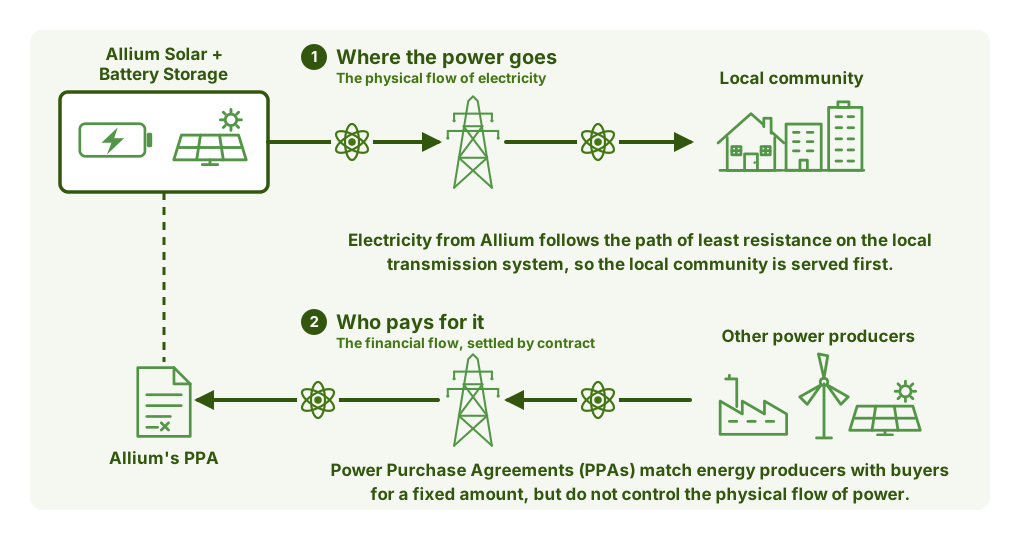
Electricity behaves a lot like water in a town’s pipes. Connect a new well to the water mains and its water takes the shortest path, so the nearest taps draw from it first. Power from Allium works the same way. It flows onto the local transmission system and follows the path of least resistance, so homes and businesses nearby are served first, and any surplus continues outward to the wider grid. Electrons cannot be directed to specific customers, but they naturally serve the closest demand.
Who pays for the power is settled separately, on paper. Think of a bank account: when you deposit cash at your local branch, the physical bills stay in town, while your balance can be spent anywhere. In the same way, contracts called Power Purchase Agreements (PPAs) decide who pays for Allium’s energy, even though the physical electricity serves the nearest demand. The figure below shows both flows side by side: where the power goes, and where the payments go.
Battery storage safety
The Allium Solar and Energy Storage System Project is proposing to use lithium iron phosphate (LFP) battery technology. The battery system will work alongside the Project’s solar panels to store energy for use in times when the sun isn’t shining or the area’s power demands are higher.
LFP battery systems are widely regarded as the most stable of all lithium-ion batteries for utility-scale projects. They have higher heat tolerance than other chemistries, such as systems using nickel or cobalt, which improves safety and reduces the risk of unplanned outages or emergencies.
Built to the highest safety codes and standards
In addition to its chemistry, the Allium Project is designed to the highest safety codes and standards in the industry:
- California Fire Code (CFC)
- NFPA 855, the national standard for the installation of energy storage systems
- UL 9540, certification to the national standard for energy storage system safety
Together, these ensure the Project meets the requirements under California law, including SB 283, SB 1383, and CPUC General Order 167.
Ensuring public safety

Project-specific emergency response plans

Local first responder training

24/7 monitoring and remote operations for rapid shutdown

Regular inspections to ensure safe operating conditions

Designed and certified to the latest codes and standards
Modern BESS reflects years of safety advances
Longroad Energy has experience working with BESS and with local fire and emergency responders to ensure that all training and emergency preparedness meets or exceeds industry standards and that local jurisdictions are equipped to ensure the public’s safety. The facility is designed with a defined safe perimeter (minimum approach distance) where emergency responders can stage without personal protective equipment (PPE).
The Electric Power Research Institute (EPRI), which maintains the industry’s most comprehensive database of battery storage incidents, reports that the global failure rate per unit of deployed capacity fell 98 percent between 2018 and 2024 as lessons from early incidents were built into newer designs, standards, and operating practices.
FAQs
-
What is battery storage?
Battery energy storage systems (commonly referred to as BESS) store electricity for use when it is needed. At Allium, the battery system will work alongside the Project’s solar panels to store energy for use in times when the sun isn’t shining or the area’s power demands are higher.
Battery storage is a proven technology in wide use. As of mid-2026, nearly 52 gigawatts (GW) of utility-scale battery storage was operating in the U.S., and more than 21 GW of battery storage now supports California’s electric grid. (Source: U.S. Energy Information Administration; California Energy Commission)
Source: Ref. 1, Ref. 2, Ref. 3.
-
How is Allium’s battery system designed for safety?
Allium’s battery system will be designed, installed, tested, and operated to the leading safety codes and standards in the industry, including the California Fire Code, NFPA 855, and UL 9540, and it will meet California’s battery storage safety laws, including SB 283, SB 1383, and CPUC General Order 167.
The Project is proposing lithium iron phosphate (LFP) batteries, widely regarded as the most stable of all lithium-ion batteries for utility-scale projects. Safety measures include a project-specific emergency response plan, local first responder training, 24/7 monitoring with remote shutdown capability, regular inspections, and a defined safe perimeter where emergency responders can stage without personal protective equipment.
Read more under Battery storage safety.
Source: Ref. 3.
-
What kind of batteries will Allium use?
The Project is proposing lithium iron phosphate (LFP) battery technology. LFP battery systems are widely regarded as the most stable of all lithium-ion batteries for utility-scale projects. They have higher heat tolerance than other chemistries, such as systems using nickel or cobalt, which improves safety and reduces the risk of unplanned outages or emergencies.
-
What safety codes and standards apply to the project?
The Allium Project is designed to the highest safety codes and standards in the industry, and it must meet California’s battery storage safety laws:
- California Fire Code (CFC): the statewide fire code. The Office of the State Fire Marshal updated it to incorporate the latest NFPA 855 standards for battery storage, effective January 1, 2026.
- NFPA 855: the national standard for the installation of stationary energy storage systems, covering everything from design and construction through operation, maintenance, and decommissioning.
- UL 9540: certification to the national standard for energy storage system safety. Fire codes also rely on the companion UL 9540A test method, which measures how a battery system behaves during a thermal runaway event at the cell, module, unit, and installation levels.
- SB 283 (2025): requires battery storage developers to consult with the local fire authority before submitting a project application and requires a fire inspection after installation and before the facility begins operating.
- SB 1383 (2022) and CPUC General Order 167 (updated in 2025): extend the California Public Utilities Commission’s maintenance and operation standards for power plants to battery storage facilities, including inspections and verification that emergency response plans are filed with the local fire department.
Source: Ref. 3, Ref. 4, Ref. 5, Ref. 6, Ref. 7, & Ref. 9.
-
What is thermal runaway, and how is it addressed?
Thermal runaway is a condition in which a battery cell experiences an internal failure that causes its temperature to rise rapidly. Modern battery storage systems are designed with multiple layers of monitoring, controls, and protection to detect abnormal conditions early and limit the potential for a failure to spread.
Allium’s proposed LFP chemistry has a higher heat tolerance than other lithium-ion chemistries. Its equipment will be certified to UL 9540, and fire codes rely on the companion UL 9540A test method to evaluate thermal runaway and fire propagation at the cell, module, unit, and installation levels.
Source: Ref. 3, Ref. 9.
-
What happens if there is a battery incident?
Allium will have a project-specific emergency response plan in place before the facility begins operating. California law requires the plan and requires it to be developed with local emergency management and fire agencies. The battery system will be monitored 24/7. If a problem is detected, operators can shut down equipment remotely, and local emergency agencies are notified under the plan’s procedures.
Local first responders will receive training on the facility, and the facility is designed with a defined safe perimeter (minimum approach distance) where emergency responders can stage without personal protective equipment (PPE).
Source: Ref. 4, and Ref. 6.
-
Will Allium provide backup power to San Benito County during an outage?
Allium will make the local grid stronger when it is under the most stress. On a hot summer evening, when demand peaks and solar output is fading, a generation and storage resource such as Allium close to home means local demand can be met with local supply instead of depending entirely on power sent in over long transmission lines. More resources in the area also means that if a power plant or an electric transmission line goes down, other resources can pick up the load, which helps keep the lights on. During California’s record September 2022 heat wave, the state’s grid operator credited battery storage with providing valuable capacity in the evening peak hours, when rotating outages were narrowly avoided. (Source: California Independent System Operator).
Allium will connect to the grid rather than to individual homes, so it is not a backup generator for your house or business, and it cannot keep power on when smaller, local lines are damaged or shut off for safety. Its job is to help prevent shortfalls in the first place, during the hours when outages are most likely.
Source: Ref. 3, Ref. 10.
-
Will the electricity generated by Allium stay local?
Electrons generated at a power plant go onto the transmission system and are distributed locally via the path of least resistance, so power from Allium will flow to nearby demand on the local transmission system. Electrons cannot be directed or routed to specific end users. Financial contracts called Power Purchase Agreements (PPAs) determine who pays for the energy, even though the physical electrons delivered may come from somewhere else.
See Supporting a reliable electric grid for more detail.
-
What is the project timeline?
The Allium Solar project timeline may shift as we complete thorough environmental studies, detailed safety reviews, and other requirements under County, State, and Federal permitting guidelines. We remain committed to working closely with County officials and community members and will continue to provide updates as the project progresses.
-
Built for San Benito County
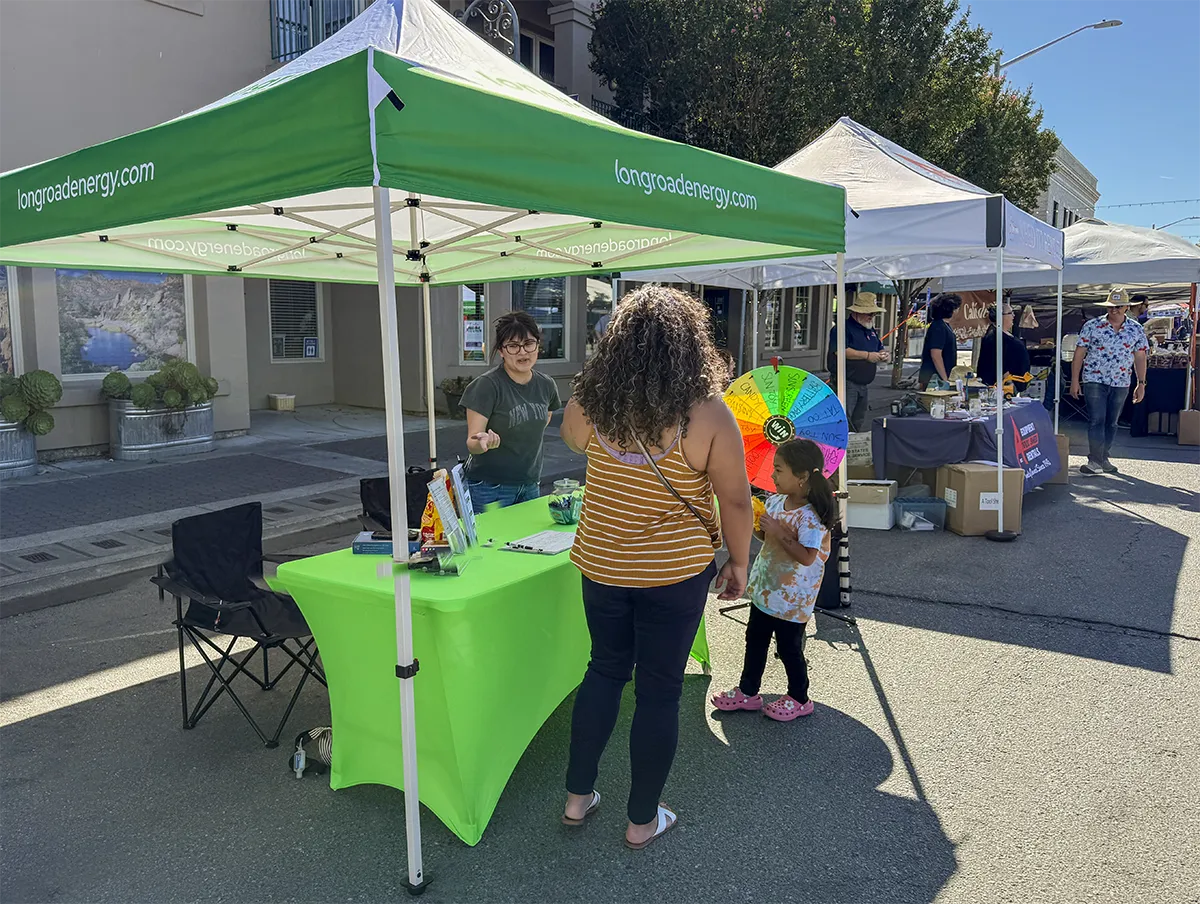
Thank you to everyone who’s taken the time to learn more about the project with us at the Hollister Farmer’s Market!
We want to hear from you
The Allium Project team is committed to open and transparent communication throughout this process.
Please reach out to us with questions by calling 831.902.4321 or completing the form below.
Fire officials, County staff, and other agency representatives are welcome to contact the project team directly to request project safety information or a briefing.