
Mahi Solar & Storage Project
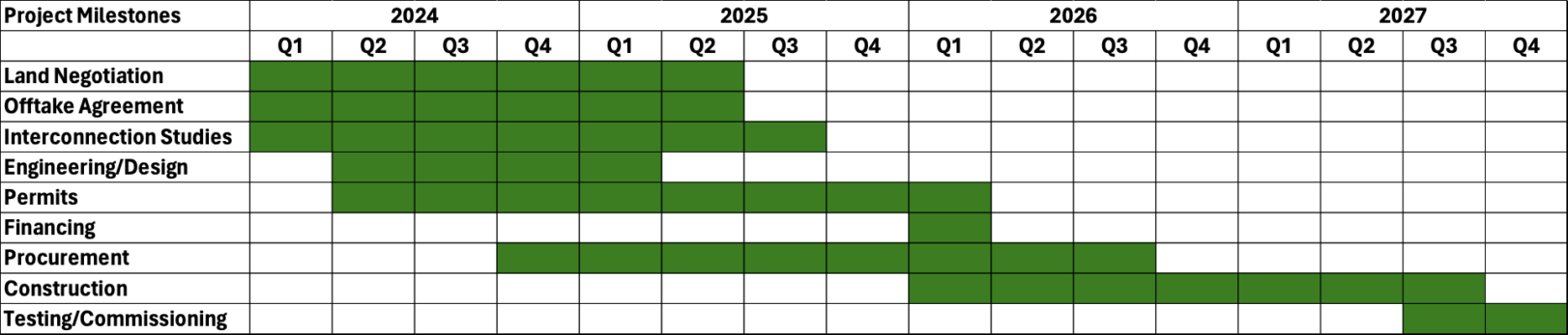
The Mahi Solar project was awarded in the Hawaiian Electric Stage 3 RFP. Previously postponed due to the global supply chain crisis, the project is now back on track to provide O‘ahu with clean, renewable energy by 2027.
Development of the project has been successful, obtaining most of the needed permits and approvals, completing all studies and most engineering, and having strong community support. In the coming weeks and months, we will be reaching out to community members and stakeholders to share information and ideas for the project. We are also working with stakeholders to provide ongoing benefits to the community in farming facilities, infrastructure and support for the agricultural industry.
Project Description
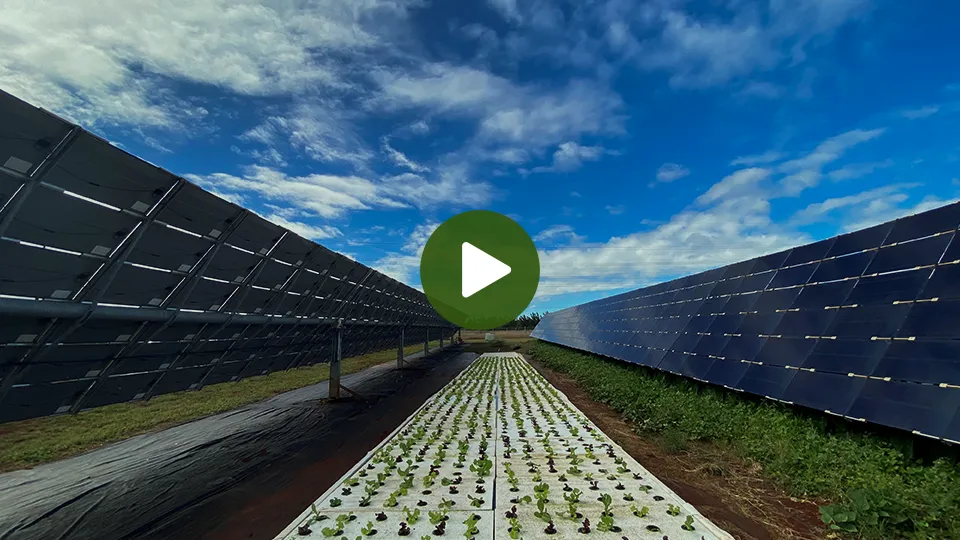
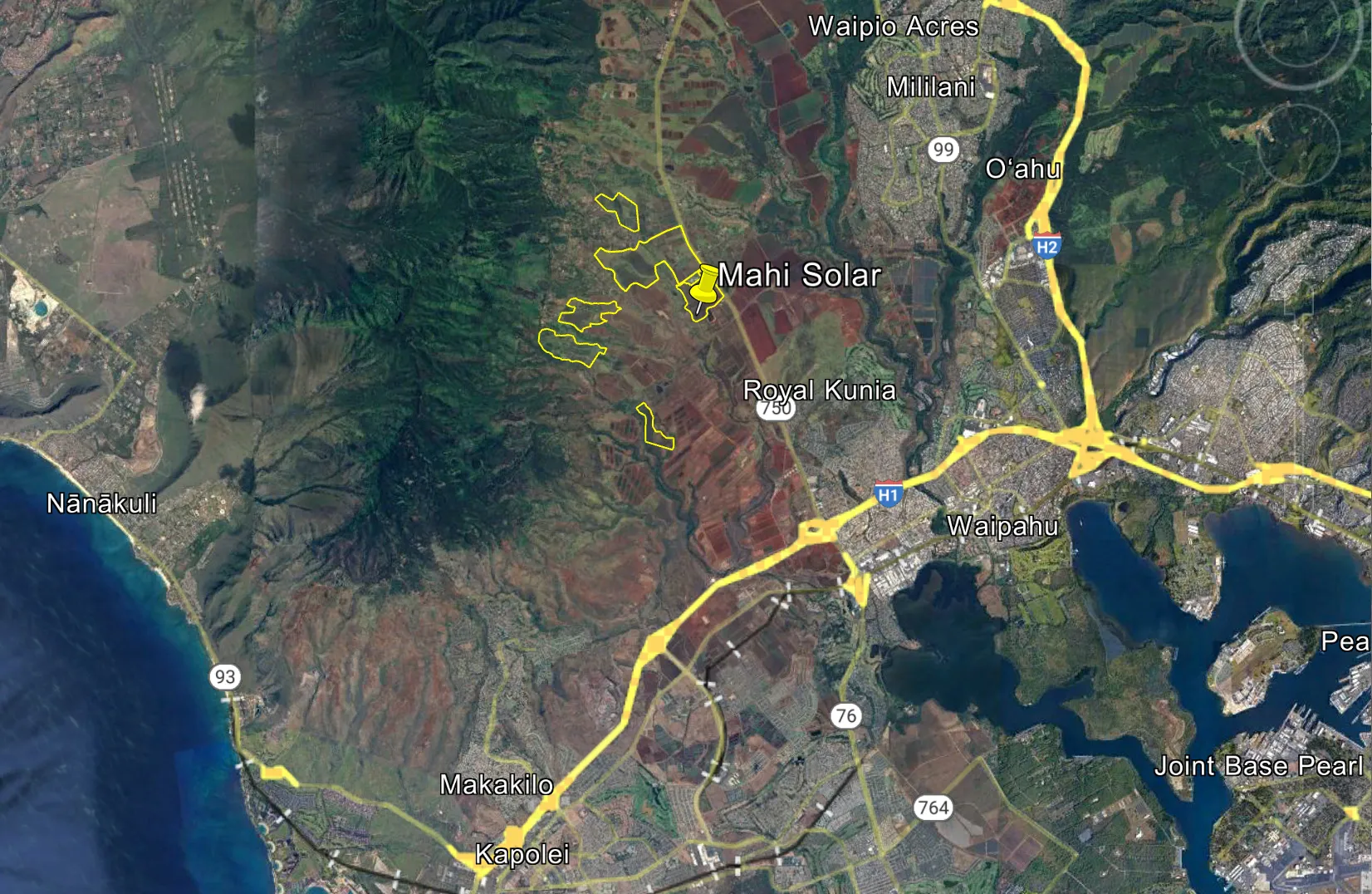
Longroad Energy is designing the Mahi Solar project to produce clean energy and support local agriculture in Kunia, O‘ahu. At 120 MW(ac), this project could produce 4% of the island’s electricity annually, enough to power 40,000 local homes, enabling HECO to burn less fossil fuel and emit less greenhouse gasses. The project includes a 480 MWh (4-hour) battery system to store solar energy generated during the day and provide power at night, and a new substation and transmission line extension to connect to the O‘ahu grid. Mahi Solar is scheduled to be completed by the end of 2027.
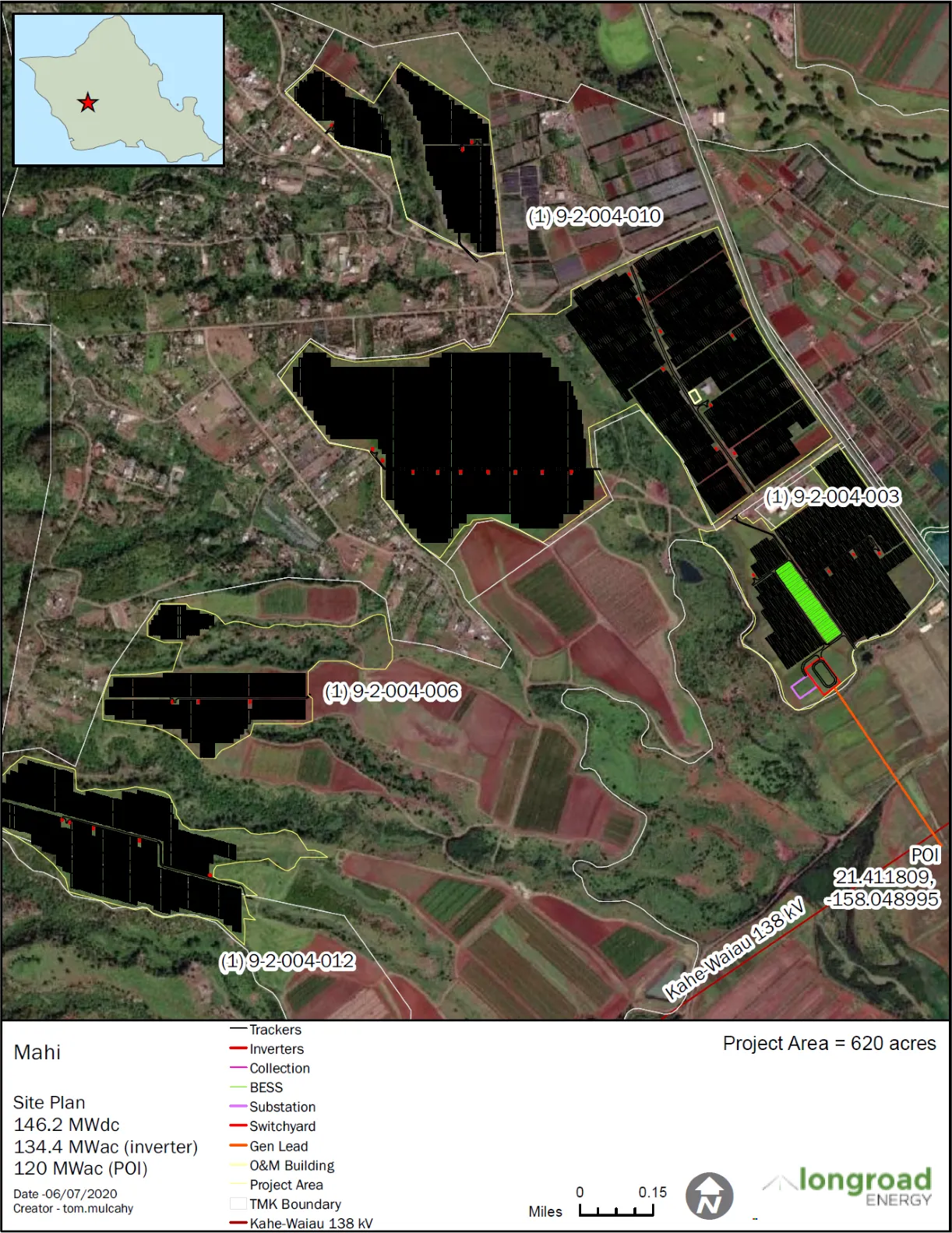
Our team at Longroad (previously as First Wind) worked successfully with local communities to develop 7 of Hawaii’s largest energy projects. The Mahi Solar project will work with local farmers to raise crops and livestock between and under PV panels. The project would occupy 617 acres across several parcels of land, on the Ewa (west) side of Kunia Road. The project would create approximately 200 jobs during construction and another 2-3 long-term positions during operations, in addition to new jobs related to farming and ranching.
The project is located away from residential areas and would be visible along Kunia Road and from a distance. The project is not expected to impact cultural activities, archaeological or natural resources. We have had many meetings and discussions with community members about the Mahi Solar project and how it can support local agriculture in Kunia. If you would like to receive further information about the project or have thoughts, suggestions or questions, please sign up for our email list.
Project Schedule and Approvals
The following is an overview of the planned project schedule and a status list of the permits and approvals that will be required.
Anticipated Permit/Approvals:
| State | Agency | Status |
|---|---|---|
| Power Purchase Agreement approval | Public Utilities Commission | Application in 2025 |
| Special Use Permit | City & County of Honolulu Planning Commission and State Land Use Commission (LUC) | Approved in 2021. Request modification in 2024 |
| Historic Preservation Review (HRS Chapter 6E) | State Historic Preservation Division (SHPD) | Approved in 2021. Submission of management plan in 2025 |
| National Pollutant Discharge Elimination System (NPDES) | State Department of Health (DOH) Clean Water Branch | Application in 2025 |
| Noise Permit | DOH Indoor and Radiological Health Branch | Application in 2025 |
| County | Agency | Status |
|---|---|---|
| Conditional Use Permit (minor) and Zoning Waiver (if needed) 1 | City & County of Honolulu Department of Planning and Permitting (DPP) | Approved in 2021. Request modification in 2024 |
| Building Permit | DPP | Application in 2024 |
| Grading, Grubbing, and Stockpiling Permit | DPP | Application in 2024 |
Potential Impacts
The positive impacts from a solar project are more clean, locally generated renewable energy, less fossil-fuel burning, less greenhouse gasses that contribute to climate changes, and hopefully lower and/or more stable electricity prices. Because of the distance of the project from residential areas, most people who live in the general area will not see the project from their homes or experience any sound, visual or other impacts. The project is not expected to create significant impacts to archaeological resources, cultural practices, or any sensitive flora or fauna.
Portions of the project will be visible along Kunia Road and at a distance from certain viewpoints between Mililani and Honolulu. If the project were to move forward, during the construction phase, there would be some additional vehicles on Kunia Road and some dust, but likely similar to what is now produced during farming in the same area. We want to gather more information from members of the communities near the project site to share information about potential impacts – positive and negative – and to hear their input and suggestions about how to improve the project for everyone.
Based on studies, the project is not expected to create significant impacts to archaeological resources, cultural practices, or any sensitive flora or fauna. Longroad conducted an initial site assessment in 2017 which looked at archaeological, cultural, biological and other environmental resources, as well as potential impacts to drainage, traffic, view plan, and many other factors. The result was that the project will create minimal, if any, negative impacts to the on-site resources or the surrounding community.
To date, no sensitive resources or unique conditions have been identified that warrant special consideration in the siting process. Based on the land use and zoning designations, the proposed solar project is consistent with state and county land use regulations, and no changes in the land use classification or zoning district would be required for project implementation. The project received approval of its archaeological assessment from the State Historic Preservation Division and received approval of its Special Use Permit from the Honolulu DPP, Planning Commission and from the State Land Use Commission. Because of the delay due to the supply chain crisis, the project will be requesting a modification to extend the dates in its Special Use Permit and Conditional Use Permit.
Community Outreach Plan
This Community Outreach Plan focuses on work with community stakeholders, including our approach, our team, outreach to date, next steps, and a summary of our community benefits discussions to date. For information about the project itself and the plan for its development, permitting, hiring, impacts, construction and operation, please refer to the appropriate section of this page.
Our Approach
Longroad is a strong proponent of community outreach and is committed to sharing information about our planned energy projects and seeking community input that reflects the neighboring community voice, insight into cultural and environmental impacts and feedback on benefits and challenges. For every project, we meet or talk with with people that live, work or spend time around the project site, or who are stakeholders in other ways, such as having family history in the area or other kuleana in or around the location.
Ensuring that residents, especially the neighboring communities of the Project, are informed and engaged is a top priority. Neighboring communities and stakeholders will be provided timely information during all phases of the project, including the Power Purchase Agreement negotiation period, the permitting process periods, and throughout construction. Through outreach efforts with stakeholders, Longroad will:
- Share information about the plans for the project from development through construction and operation
- Ask for ideas and input that could help improve the project for the community
- Identify concerns about the project and discuss ways to solve or mitigate
- Discuss what additional benefits the project could provide to the community
- Identify a community point of contact in Longroad responsible for the Project development
Our Team
Longroad’s local team has extensive experience with community outreach for previous renewable energy projects developed from 2005 to 2015 by Longroad Energy and First Wind, including Kaheawa Wind, Kahuku Wind, Kawailoa Wind, Kawailoa Solar, Waipio Solar and Lanikuhana/Mililani II Solar. Longroad has established a reputation for engaging with community members early, being accountable in communicating, and listening to community input in order to modify projects to mitigate negative impacts. The community engagement team for the Project also includes consultants, Kawika McKeague (Principal at G70), Donalyn Dela Cruz (DDC Consulting), both of whom bring extensive local knowledge and many relationships community leaders, government officials and cultural practitioners in the affected communities. Members of the team include kanaka (of Native Hawaiian descent) and keiki o ka ʻāina (from Hawaiʻi), who are vested in the improvement of Hawaiʻi’s future for generations to come.
Outreach to Date
Longroad began the process of community outreach regarding the Mahi project in 2017. We contacted and spoke with many people in and around the greater Kunia area, which we consider the “host community,” including individual residents, farmers, organizations, businesses, community leaders and government officials. We also conducted public meetings online and community meetings at Kunia Village and Kunia Loa Ridge Farmlands. We also identified other people who could provide feedback and suggestions about history, impacts to the landscape and cultural significance. Some of Longroad’s community outreach efforts focus on Native Hawaiian culture, including conducting initial community outreach and engagement with identifiable loea (practitioners), kumu (cultural teachers) or kupuʻāina (individuals with genealogical ties to the area) as a means to introduce the project as a concept and to seek to understand the perspectives, beliefs, and range of opportunities and concerns that these individuals may have regarding the project area and its historical/cultural context; its resources; and/or the nature of the project’s perceived impact on those elements.
So far, community reaction to this project has been mostly positive or neutral. The majority of community members’ comments have expressed support or acceptance about renewable energy generally and an understanding that renewables will replace fuel-based generation over time. Very few community members expressed concerns about the Project, either through more critical questions or occasionally stating their opposition to the proposed project. Compared to other projects that the Longroad team has developed in Hawai‘i, the Mahi Solar project has received the fewest negative comments or concerns so far.
When the project was postponed in 2022, the Longroad team notified our community contacts, and explained that we hoped to resume the project once it was selected to the final award group in the Stage 3 RFP. Now that the project has been awarded, we will be resuming active community outreach work, reaching out to stakeholders and continuing discussions around community benefits. If you would like to be included in future updates, please join our email list. If you have ideas for other organizations to include in our outreach, please contact us any time.
Next Steps in Outreach
In 2024, we plan to do the following:
- Reach out to existing stakeholders via email or phone to provide update on the project
- Publish updated project web page with information on the project
- Share contact information so that interested people can easily contact us about the project
- Publicize and conduct online and/or in-person community meetings about the project
- Expand the list of current contacts to engage more community members in planning efforts
- Conduct individual conversations with individuals, community groups, organizations, businesses, stakeholders, and government officials
- Continue conversations with stakeholders on developing community benefits
In 2025, leading up to construction of the project, we plan to:
- Inform community members about pre-construction and construction activities including potential impacts to the community
- Maintain open method of communication so that community concerns can be addressed
- Finalize community benefits commitments and agreements
- Once the project is completed in 2027, we will maintain an ongoing communication channel throughout operations to receive and share info with community.
Community Benefits
We believe that the additional benefits that a project provides to the local community should be designed in consultation with community members. In many conversations with stakeholders about the Mahi Solar Project, the consensus has been that Kunia has long been an agricultural area, and the Project’s community benefits should focus on supporting agriculture and farmers.
Mahi Solar will provide at least $500,000 annually in community benefits for the Project after it begins operations. We have been working with many stakeholders to develop a community benefits package that details where and how those funds will be spent, and what written commitments or agreements will be included to ensure that funding continues during the life of the projects. So far, Longroad has already made contributions the Hawai‘i Agriculture Foundation ($30,000) and the Agricultural Leadership Foundation of Hawai‘i ($5,000), as well as a 3-year investment ($380,000 spent or committed to date) in an Agrivoltaic research program by the Hawai‘i Agriculture Research Center (HARC) to study what types of crops can be successfully farmed under solar panels in Hawai‘i. Thanks to Longroad’s initiative, HARC’s Agrivoltaic research is now also co-funded by other solar developers, in the interest of sharing results with the solar and agricultural industries and finding new ways to use our limited land for both agriculture and renewable energy. It is possible that Mahi Solar will be the largest agrivoltaic project in the United States, combining both commercial solar and commercial farming, and potentially developing new opportunities for sustainable, local food production.
Ideas for other agricultural benefits include: increasing row spacing in parts of the Project to facilitate certain types of farming, keeping some parts of the site open (no Project equipment) to construct shared farming facilities for washing or packing produce, a potable water system for washing produce, as well as providing other benefits to local farmers. These general commitment areas below have been proposed by members of the surrounding community in many meetings and conversations to date. More specifics on how and where funds are spent, the beneficiaries, actual agreements – will be developed in further community discussions. If you have other ideas for benefits, please contact us.
| Commitment Area | Percentage |
|---|---|
| Support for Local Farmers & Ranchers | 80% |
| Agricultural Research | 10% |
| Organizations Supporting Agriculture | 10% |
| TOTAL | 100% |
Additional Plan Details
Community Outreach Plan Elements:
Elements of Longroad’s Community Outreach Plan include the following:
Individual and Small-Group Stakeholder Conversations
Longroad has already engaged in dozens of individual and small group conversations with community members, including residents, kupuna, business owners, nonprofit groups, cultural practitioners and government officials. Outreach is made through email, phone and word-of-mouth, to engage with individual stakeholders. Conversations often occur in-person, over the phone or online videoconference, and occasionally via email. Questions, concerns and comments are logged for later follow up as needed and generate ideas for benefits to be discussed more broadly with communities.
Community Meetings: Virtually accessible
Longroad will plan both in-person and virtual community meetings to ensure that the community is well informed and has an opportunity to provide feedback. There will be advanced information shared in preparation with key stakeholders. To ensure widespread accessibility, community meetings will be televised on Nā Leo TV. Options to attend the meeting virtually will also be made available to allow for live engagement.
Notification of Meetings
Longroad will advertise in the community papers about any community meetings two weeks in advance of the meeting in community publications. This is in addition to email notifications to stakeholders and those who have signed up for updates. Media advisories regarding public meetings will be issued to O‘ahu and statewide media, which includes but is not limited to: Honolulu Star-Advertiser, Civil Beat, Hawai‘i News Now, KHON2 News, and KITV News.
Educational Kiosk
Longroad proposes to set up an educational kiosk, at or near the Project site, where people can access information about the project on their own time. This educational kiosk will be advertised in the local media and in mailings to share with residents that it is available. This kiosk would be designed in collaboration with Hawaiian Electric as a demonstration site that highlights renewable energy needs and the benefits the Project provides in that community.
Website: longroadenergy.com/mahi
Longroad will post information regarding the project to this website – including this communication plan. The website will offer an option to sign up for updated information and have an email address for inquiries. Emails will then be added to the distribution list that will be another aspect of ongoing public communication.
Email: mahisolar@longroadenergy.com
Longroad will provide email updates prior to meetings, and periodically, to a distribution list of stakeholders. We have also established an email address, so that inquiries regarding the Project can be directed here.
Public Comments
Supportive and opposing comments and feedback will be gathered throughout the outreach process. These will be compiled and filed with the Public Utilities Commission.
Contact
For more information, sign up below to be on our project email list.
"*" indicates required fields